When Does Leading a Double Life Cross the Line Into Psychological Abuse?
Discover when a partner’s double life stops being simple dishonesty and crosses the line into coercive control and covert psychological abuse.
Cheating breaks trust, but leading a double life fractures your perception of reality.
Many survivors ask themselves: If cheating is not in itself a crime, when might the act of leading a double life be considered emotional and psychological abuse?
The distinction lies in the intentionality, scale, and long-term damage of the deception. It isn’t just about hidden messages or secret meetings, it is about the systematic destruction of your emotional autonomy.
Beyond Infidelity: The Mechanics of Covert Deception
Infidelity involves a breach of faith, but a calculated double life requires a complex architecture of deceit. When a partner maintains parallel worlds, their secret depends on keeping you disoriented.
The psychological toll comes from the daily environment created to protect that secret. You are forced to live in a reality engineered specifically to keep you in the dark.
Over time, this dynamic shifts from mere romantic betrayal into a pattern of covert emotional abuse.
4 Indicators That Deception Has Crossed into Abuse
Mental health professionals and family court experts look beyond the act of cheating itself to evaluate the broader pattern of behavior. Here are the primary factors that turn chronic dishonesty into psychological abuse:
1. Systematic Gaslighting and Reality Denial
When you sense something is wrong, a partner living a double life cannot afford to tell the truth. To protect the lie, they must convince you that your intuition, memory, or sanity is failing.
- They turn your valid questions back on you, calling you paranoid or insecure.
- They manufacture complex covers—even fake confessions—to hide deeper, ongoing betrayals.
- They rewrite history so smoothly that you begin to distrust your own eyes and ears.
2. Coercive Control and Isolation
Maintaining a secret life requires strict control over the environment. To keep their parallel world hidden, an abusive partner will often attempt to limit your scope of awareness.
- They may subtly isolate you from friends or family who might spot the inconsistencies.
- They use mood swings, silent treatments, or manufactured outrage to make you afraid to ask basic questions.
- They manipulate your daily schedule to create unaccounted-for pockets of time for themselves.
3. Financial Harm and Exploitation
A secret life is rarely free. Funding secondary relationships, secret accommodations, or covert lifestyle choices often drains joint resources without your consent.
- Shared marital funds are quietly siphoned away to finance the secondary life.
- Assets are hidden, or debt is acquired in your name to sustain the deceit.
- You are kept financially dependent or misinformed to prevent you from discovering the truth.
4. Severe and Prolonged Psychological Harm
A single lie is a mistake; a chronic web of deception designed to confuse and degrade you is a campaign of emotional harm.
The chronic stress of living alongside hypervigilance, unexplainable gut instincts, and constant minimisation takes a massive toll on your nervous system. Victims often experience severe anxiety, clinical depression, and symptoms aligned with Complex PTSD (C-PTSD) long after the final discard.
What the Law and Psychology Say
While cheating alone is rarely criminalised in modern legal systems, legal experts and psychological practitioners increasingly recognise covert non-physical abuse.
Courts in many jurisdictions now evaluate patterns of coercive control, looking at how deception is weaponised to strip away a partner’s agency, independence, and psychological safety.
When dishonesty ceases to be a personal flaw and becomes a calculated mechanism to subjugate another person, it moves firmly out of the realm of simple heartbreak and directly into the realm of psychological abuse.
Reclaiming Your Ground
If you discovered that your relationship was built on a foundation of structural lies, your pain is not just about a lack of love. It is the natural response to having your reality deliberately manipulated.
- Validate your experience: You were not “foolish” for believing the reality presented to you; you were targeted by intentional deception.
- Trust your body: The anxiety or confusion you felt during the relationship was your nervous system warning you that the narrative didn’t match reality.
- Focus on your safety: Rebuilding begins when you step away from trying to make sense of their lies and focus entirely on your healing.
You deserve a life rooted in clarity, genuine respect, and absolute truth.
If you are processing the aftermath of a covert relationship, here are a few ways we can continue:
Learn how to document evidence of financial abuse or coercive control.
Book A Video Call
Explore strategies for breaking trauma bonds after betrayal.
Book A Video Call

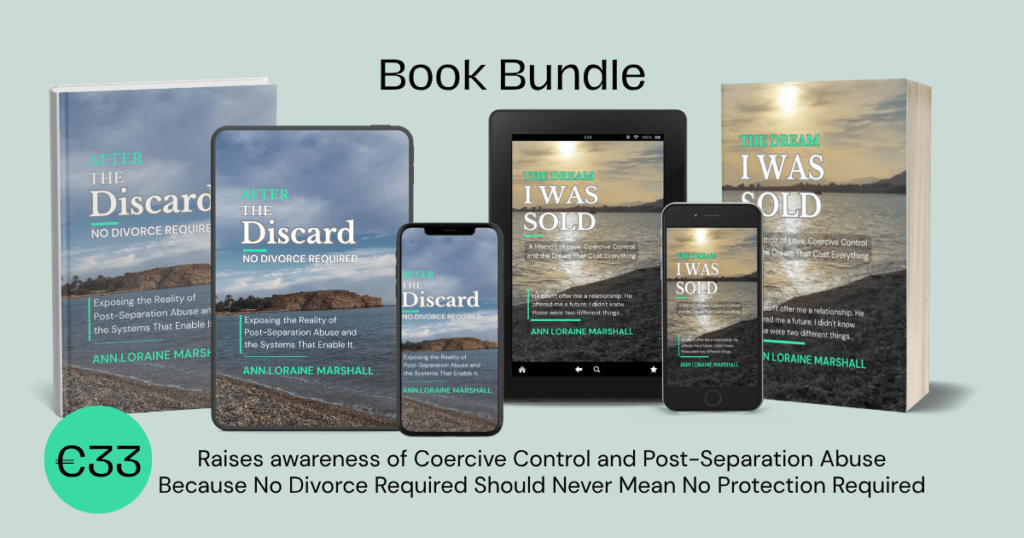
Book Bundle: The Dream I Was Sold + After The Discard.

Book 2. After The Discard
No Divorce Required Should never mean no protection required.